⚡ Service: intensive therapy — high-dose rehabilitation programmes for faster progress See the programmes →
Blog Contact
Information appointment Free and without obligation
Condition · information & therapy

Therapy for neuromuscular conditions in Vienna & Graz — specialist neurological therapy centre

Individual physiotherapy and occupational therapy in muscle disease — building strength without overloading, with a clear focus on everyday function.

📝 Neuromuscular conditions cover more than 150 different diseases — many are rare, but their effect on daily life and mobility is considerable.

💲Sessions from €80 🛡️Health insurance contribution possible See all prices →
WHAT ARE NEUROMUSCULAR CONDITIONS?

Understand what is happening

Explained medically

Neuromuscular conditions cover more than 150 different diseases: muscular dystrophies (Duchenne, Becker, FSHD), myopathies, myasthenia gravis, Lambert-Eaton syndrome and disorders of neuromuscular transmission. What they share: progressive muscle weakness and muscle wasting.

Experienced in everyday life

Muscles that are no longer as strong as they were. Movements that cost more effort. Stairs that become a challenge. Neuromuscular conditions often progress slowly — and keep asking those affected to adapt. Focused therapy can slow this process and keep independence for longer.

Working together with your consultant

Specialists in functional therapy for neuromuscular conditions

Neuromuscular conditions are diagnosed by neurologists, often with genetic testing as well. We are your specialists for functional therapy: maintaining muscle strength, mobility and everyday ability, matched to the particular diagnosis and its course. We work closely with your medical findings and your treating team. The focus is on building strength within safe limits, walking safely, joint mobility and assistive devices.

How does it feel?

What people with this condition experience

Neuromuscular conditions mainly affect the muscles — and with them mobility, everyday activities and quality of life.

Medical
Proximal muscle weakness
In everyday life

Muscles close to the trunk — shoulder, hip — become weaker. Raising the arms above the head is hard. Getting up from sitting needs help.

Medical
Gait problems / waddling gait
In everyday life

The way you walk changes. Stairs become increasingly difficult. Longer distances are quickly exhausting.

Medical
Muscle wasting (atrophy)
In everyday life

The muscles visibly shrink. Strength declines. Everyday tasks that used to be a matter of course now need aids or help.

Medical
Rapid fatigability
In everyday life

The muscles tire very quickly. A short physical effort is exhausting out of all proportion — which limits daily life and taking part in things.

Specialised in what is rare

Neuromuscular conditions are rare — which makes a team that knows them all the more important. At HOME4MOTION our therapists have experience across a wide range of neuromuscular conditions.

First appointment free and without obligation · Mon–Fri 08:00–16:00
How to reach us

Getting started is simple

Straightforward, personal, no waiting list.

1
Free and without obligation

Free initial consultation

Tell us about your difficulties — muscle weakness, limitations in walking or fine motor control, or exhaustion in daily life. We explain which therapies make sense for your particular condition and whether we are the right place for you.

2
Approx. 90 minutes

First appointment & assessment

We carry out a full assessment: strength, stamina, gait and everyday function — matched to the condition. From this comes an individual therapy plan that avoids overloading you while building what can be built.

3
100% individual

Your personal therapy

Regular sessions of physiotherapy and occupational therapy — matched to what you can manage and to your progress. At the end there is a follow-up assessment recording how you have developed.

From our practice

What our clients say

Real experiences, real progress — how our clients have regained independence, confidence and quality of life despite their diagnosis.

Neuromuscular conditions

Finally someone who understands that I cannot simply train more. The therapy is genuinely built around me.

Mr P., 52, Vienna — facioscapulohumeral muscular dystrophy (FSHD)
A person with a neuromuscular condition at home, coping with loss of muscle strength and limited mobility, supported by HOME4MOTION.

An account after a spinal cord injury

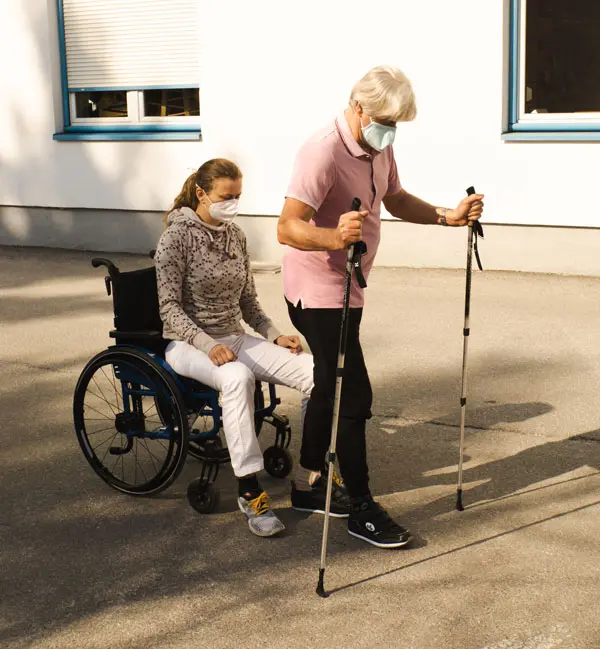
After an operation on the spine, Klaus’s spinal cord was injured. The result: paralysis of the left leg and the abdominal muscles, and with it the loss of his ability to walk. Since June 2021 he has had movement therapy at HOME4MOTION and can now walk again with support and Nordic walking poles.

Read the whole story →
Frequently asked questions

Neuromuscular conditions: common questions about therapy

Answers to the most common questions about your condition and therapy — explained clearly and gathered in one place. So you can read at your own pace and come to your appointment well prepared and at ease.

What are neuromuscular conditions?▾
Neuromuscular conditions are a group of diseases in which the motor nerves, nerve roots, the neuromuscular junction or the muscle itself are damaged. Examples are muscular dystrophy, myasthenia gravis and Charcot-Marie-Tooth disease, among others. All of them lead to muscle weakness and restricted mobility.
Which therapies help in neuromuscular conditions?▾
Rehabilitation includes physiotherapy (strength, stamina, preventing contractures), occupational therapy (everyday skills, assistive devices) and speech and language therapy where there are swallowing or speech problems. HOME4MOTION offers specialist outpatient therapy for neuromuscular conditions in Graz and Vienna.
Can you exercise with a neuromuscular condition?▾
Adapted physical activity is advisable in most neuromuscular conditions — under professional guidance. Too much exertion can do harm, but well-judged training can improve muscle strength and quality of life. Our team at HOME4MOTION develops safe training programmes.
Which assistive devices make sense in neuromuscular conditions?▾
Depending on the condition and the limitations, orthoses, wheelchairs, grabbers, communication aids or breathing aids may be appropriate. Our occupational therapy team at HOME4MOTION advises you fully on the best provision and supports the fitting in Graz and Vienna.
How does rehabilitation work in progressive neuromuscular conditions?▾
In progressive conditions therapy is adjusted regularly to your current state. The aim is to preserve the function you have for as long as possible and to maximise independence. HOME4MOTION supports you continuously — not only in acute phases.
What part does respiratory therapy play in neuromuscular conditions?▾
In many neuromuscular conditions the breathing muscles are affected. Focused breathing exercises and respiratory therapy can preserve lung function and prevent complications. Our physiotherapy team at HOME4MOTION specialises in respiratory therapy for neuromuscular conditions.
How do you find the right therapy for a rare neuromuscular condition?▾
In rare conditions specialist knowledge matters especially. HOME4MOTION works with an experienced team of neurological therapists who cooperate regularly with treating neurologists. We look at your situation and draw up a therapy plan made for you.

Your first step starts here

In a free initial consultation we show you what is possible with your condition — in person, by phone or online.

First appointment free and without obligation · Mon–Fri 08:00–16:00