
⚡ Service: intensive therapy — high-dose rehabilitation programmes for faster progress See the programmes →
Blog Contact
Information appointment Free and without obligation
Condition · information & therapy

Therapy for incomplete spinal cord injury in Vienna & Graz — specialist neurological therapy centre

Targeted gait and function training in incomplete spinal cord injury — we work consistently with the potential that remains.

🎯 In an incomplete spinal cord injury some nerve pathways are preserved — which means there is potential for measurable improvement through intensive therapy.

💲Sessions from €80 🛡️Health insurance contribution possible See all prices →
WHAT IS AN INCOMPLETE SPINAL CORD INJURY?

Understand what is happening

Explained medically

Incomplete spinal cord injury means that some nerve pathways below the level of the lesion are preserved. Depending on the ASIA classification (AIS B, C or D) the remaining potential varies considerably. Neuroplasticity and high-dose training are decisive for improvement.

Experienced in everyday life

Some movements work — others do not. Sometimes a sensation arrives, sometimes it does not. Incomplete spinal cord injury is individual and unpredictable — what sets it apart from a complete injury is the potential: with focused intensive therapy, remaining function can be built up and new abilities developed.

Working together with your consultant

Specialists in rebuilding function after incomplete spinal cord injury

Diagnosis and medical care in incomplete spinal cord injury lie with trauma surgeons, orthopaedic surgeons and neurologists. As specialists in rehabilitation after incomplete spinal cord injury our focus is on building up the motor and sensory function that remains, and on improving walking. We work from your medical findings and adapt therapy to how your recovery progresses. The focus is on gait training, balance, building strength and sensory training.

How does it feel?

What people with this condition experience

Incomplete spinal cord injury shows itself very differently in each person — depending on which nerve pathways are preserved.

Medical
Partial movement limitations
In everyday life

Some muscles work — others do not. What works, and how much, differs from person to person and can improve with focused therapy.

Medical
Partial sensory disturbance
In everyday life

Sensations arrive in part — but altered. Tingling, burning

Medical
Spasticity
In everyday life

Involuntary muscle contractions that make movement harder, cause pain or get in the way — but can also be seen as a sign that function remains.

Medical
Unsteady walking
In everyday life

Walking is possible — but uncertain and slow.

Your potential is waiting for focused training

In incomplete spinal cord injury the intensity of therapy makes the difference. With Lyra, Perpedes and a specialist team we draw the most from the nerve pathways you still have.

First appointment free and without obligation · Mon–Fri 08:00–16:00
How to reach us

Getting started is simple

Straightforward, personal, no waiting list.

1
Free and without obligation

Free initial consultation

Tell us about your difficulties — remaining sensation, partial paralysis, spasticity or unsteadiness when walking. We explain what potential rehabilitation holds in incomplete spinal cord injury and whether we are the right place for you.

2
Approx. 90 minutes

First appointment & assessment

We analyse your gait, your balance with the Balo system, how strength is distributed and your sensation. From this comes a therapy plan built specifically on the potential you still have.

3
100% individual

Your personal therapy

Regular sessions of intensive gait and functional training — matched to your progress. At the end there is a follow-up measurement showing what you have achieved.

From our practice

What our clients say

Real experiences, real progress — how our clients have regained independence, confidence and quality of life despite their diagnosis.

Incomplete spinal cord injury

I felt my body taking in signals again. Every session was a discovery of what is still possible.

Mrs B., 47, Vienna — incomplete spinal cord injury C5/C6, ASIA C
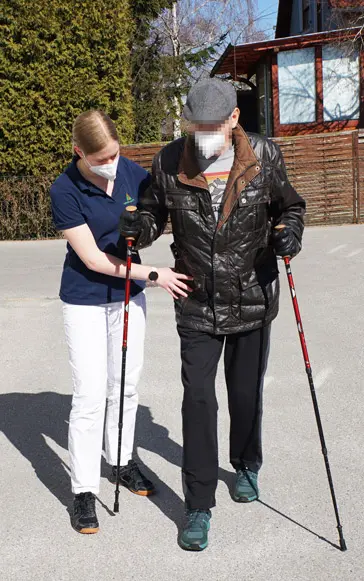
A person with an incomplete spinal cord injury at home, with partial walking ability and limited mobility, supported by HOME4MOTION.

From wheelchair to mushroom picking

After complications following surgery the diagnosis was an incomplete spinal cord injury. With boundless determination and intensive movement therapy, Leo R. made it back into the woods to pick mushrooms, on crutches.

Read the whole story →
Frequently asked questions

Incomplete spinal cord injury: what to expect in therapy

Answers to the most common questions about your condition and therapy — explained clearly and gathered in one place. So you can read at your own pace and come to your appointment well prepared and at ease.

What does incomplete spinal cord injury mean?▾
In an incomplete spinal cord injury, motor and/or sensory function below the level of the damage is partly preserved. That means there is remaining function which focused rehabilitation can build on and develop.
What are the prospects in incomplete spinal cord injury?▾
The outlook in an incomplete injury is markedly better than in the complete form. With intensive neurological rehabilitation — physiotherapy, occupational therapy, gait training — many people regain significant function, in some cases full walking ability.
Which therapies help in incomplete spinal cord injury?▾
Physiotherapy (gait training, building strength, coordination), occupational therapy (hand function, everyday skills) and neuropsychology are the central parts of rehabilitation. HOME4MOTION uses the most modern methods and supports people as outpatients in Graz and Vienna.
Can you walk again after an incomplete spinal cord injury?▾
In many people with an incomplete spinal cord injury, walking can be restored — at least in part. What matters is the severity of the damage, an early start to therapy and the intensity of rehabilitation.
How long does recovery take after incomplete spinal cord injury?▾
Recovery can take months to years. The greatest progress is often made in the first six to twelve months. HOME4MOTION supports you long term with regular sessions — as an outpatient in Graz and Vienna.
How does therapy differ between complete and incomplete spinal cord injury?▾
In incomplete injury the focus is on activating and strengthening the function that remains — through intensive gait training and coordination work, for example. In complete injury the emphasis is on compensation and on making the best use of assistive devices.

Your first step starts here

In a free initial consultation we show you what is possible with your condition — in person, by phone or online.

First appointment free and without obligation · Mon–Fri 08:00–16:00