
⚡ Service: intensive therapy — high-dose rehabilitation programmes for faster progress See the programmes →
Blog Contact
Information appointment Free and without obligation
Condition · information & therapy

Parkinson’s therapy in Vienna & Graz — specialist neurological therapy centre

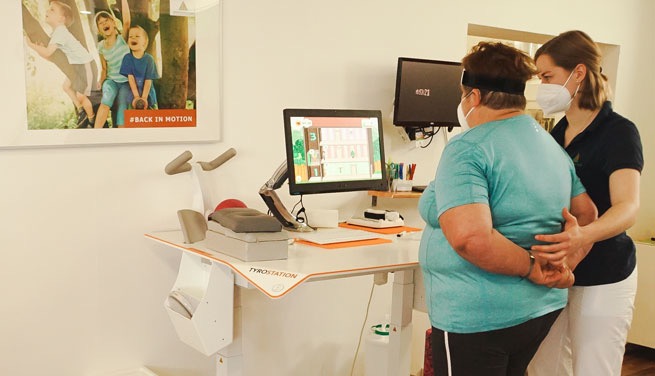
Targeted gait and balance training in Parkinson’s disease — for more confidence in everyday life and a proven reduction in falls. Equipment for people with Parkinson’s: the Lyra gait trainer for safe gait training, the Balo system for objective balance measurement. HOME4MOTION — your Parkinson’s specialists in Vienna & Graz.

🏫 Around 20,000 people in Austria live with Parkinson’s disease — a number that is rising as the population ages.

💲Sessions from €80 🛡️Health insurance contribution possible See all prices →
WHAT IS PARKINSON’S DISEASE?

Understand what is happening

Explained medically

Parkinson’s disease is a progressive neurodegenerative condition caused by the loss of dopamine-producing nerve cells. The three main motor symptoms are tremor (at rest), rigidity (muscle stiffness) and bradykinesia (slowness of movement). Alongside these come non-motor symptoms such as hypophonia (a quiet voice), dysphagia (swallowing problems in Parkinson’s) and cognitive changes.

Experienced in everyday life

The glass trembles in the hand. Steps become smaller — short, shuffling steps in Parkinson’s make every journey uncertain. While walking you freeze on the spot. The voice grows quieter — conversations on the phone become impossible. Parkinson’s creeps in — barely noticeable at first, then ever more present in daily life.

Working together with your consultant

Specialists in Parkinson’s rehabilitation — your neurologist stays on board

Diagnosis and medication in Parkinson’s disease are handled by your neurologist. We are your specialists for Parkinson’s rehabilitation and add focused movement and functional therapy to that medical treatment. Research shows that regular specialist training can demonstrably slow motor symptoms — whether alongside medication or independently of it. We focus on gait, freezing, balance and rigidity, and on voice and swallowing in hypophonia and dysphagia.

How does it feel?

What people with this condition experience

Parkinson’s affects movement, voice, balance and cognition — often together. Here are the most common symptoms in medical and everyday language.

Medical
Bradykinesia / akinesia
In everyday life

Movements become slower — getting dressed takes twice as long as it used to. Getting up from a chair takes several attempts. Sometimes you freeze on the spot.

Medical
Rigidity
In everyday life

The muscles feel stiff — like a body that has not quite thawed. Turning the trunk is hard. The stiffness is worst in the morning.

Medical
Tremor
In everyday life

The hand shakes when held in the air — holding a cup makes it better, but other people notice and ask. The shaking comes and goes.

Medical
Hypophonia / dysarthria
In everyday life

The voice grows quieter — conversations on the phone become difficult. The family asks more and more often: “Can you speak up?” That is tiring and frustrating.

Medical
Balance problems / risk of falling
In everyday life

Steps become smaller and narrower. Balance is lost when turning. Falls become more frequent — and the fear of the next one grows.

Medical
Cognitive changes
In everyday life

Multitasking becomes harder. Planning takes more effort. Sometimes thinking stalls — much as the body does when walking.

Parkinson’s cannot be stopped — but it can be influenced

Research is clear: people with Parkinson’s who receive regular specialist therapy keep their abilities markedly longer. Start now — the earlier the better.

First appointment free and without obligation · Mon–Fri 08:00–16:00
How to reach us

Getting started is simple

Straightforward, personal, no waiting list.

1
Free and without obligation

Free initial consultation

Tell us about your difficulties — slower walking, balance problems, short shuffling steps or difficulty in daily life. We explain what rehabilitation can do in Parkinson’s and whether we are the right place for you.

2
Approx. 90 minutes

First appointment & assessment

We measure your balance objectively with the Balo system, analyse your gait and assess your motor function. From this comes your individual therapy plan, focused on mobility and preventing falls.

3
100% individual

Your personal therapy

Regular sessions of focused gait and balance training — matched to your progress. At the end there is a follow-up measurement showing what you have achieved.

From our practice

What our clients say

Real experiences, real progress — how our clients have regained independence, confidence and quality of life despite their diagnosis.

Parkinson’s disease

My walking has become safer. I fall less often. That sounds simple — but for me it has changed everything.

Mr W., 71, Graz — Parkinson’s disease, Hoehn & Yahr stage III
A person with Parkinson’s disease at home, coping with limitations of movement and balance, supported by HOME4MOTION.

Parkinson’s as an opportunity — a personal account

Uli Sajko has lived with Parkinson’s disease for 20 years. Despite the limitations the illness brings, she refuses to let it get her down and even sees Parkinson’s as an opportunity. At HOME4MOTION she has regular movement therapy, which supports her in keeping the greatest possible quality of life and independence.

Read the whole story →
Frequently asked questions

Parkinson’s disease: common questions about therapy and rehabilitation

Answers to the most common questions about your condition and therapy — explained clearly and gathered in one place. So you can read at your own pace and come to your appointment well prepared and at ease.

Is Parkinson’s disease curable?▾
Parkinson’s disease cannot be cured at present. With a combination of medication, physiotherapy, occupational therapy and speech and language therapy, however, the symptoms can be markedly eased and quality of life preserved in the long term. Around 20,000 people in Austria live with this diagnosis.
Which therapies help in Parkinson’s disease?▾
In Parkinson’s we use physiotherapy (mobility, balance, gait training), occupational therapy (fine motor control, everyday skills) and speech and language therapy (speech and swallowing). HOME4MOTION offers specialist outpatient Parkinson’s therapy in Graz and Vienna — matched to every stage of the illness.
How does physiotherapy slow the progression of Parkinson’s?▾
Regular physiotherapy trains mobility, balance and coordination. Research shows that active exercise therapy can slow the progression of Parkinson’s symptoms. Our team recommends continuous support — not only at advanced stages, but from the very beginning.
What can be done about speech problems in Parkinson’s?▾
A quiet, monotone voice and difficulty swallowing are common symptoms of Parkinson’s. Speech and language therapy — particularly specialist breathing and speech work — helps preserve the ability to communicate in the long term. HOME4MOTION offers speech and language therapy for people with Parkinson’s in Graz and Vienna.
How does Parkinson’s change over the course of the illness?▾
Parkinson’s disease progresses slowly. At first motor symptoms such as tremor and slowness predominate. Over time, autonomic disturbances, cognitive changes and psychological symptoms may be added. Therapy is adjusted continuously — our team supports you at every stage.
How often should Parkinson’s therapy take place?▾
The frequency depends on the stage of the illness. In early phases specialists recommend regular sessions to keep symptoms stable. At advanced stages intensive therapy matters particularly. HOME4MOTION matches the frequency to your situation.
What part do family members play in Parkinson’s therapy?▾
Family members are an important part of the therapy team. They support home exercises, notice changes early and ease the daily load. HOME4MOTION advises families on care strategies and involves them actively in planning therapy.

Your first step starts here

In a free initial consultation we show you what is possible with your condition — in person, by phone or online.

First appointment free and without obligation · Mon–Fri 08:00–16:00