
Modern movement therapy in multiple sclerosis — a personal account
Multiple sclerosis in a progressive form. The process from the first symptoms to the diagnosis took a full year and a half.
Read the whole story →Physiotherapy, occupational therapy and recoveriX in MS — adapted to relapses, fatigue and your personal goals.
👥 Around 12,500 people in Austria live with multiple sclerosis — the most common neurological condition in young adults.
Multiple sclerosis (MS) is a chronic inflammatory disease of the central nervous system in which the immune system attacks the myelin sheaths of the nerve fibres. Nerve signals are slowed or interrupted. MS follows a relapsing-remitting (RRMS), secondary progressive (SPMS) or primary progressive (PPMS) course.
Some days are good. Then comes MS fatigue — an exhaustion that no amount of sleep repairs. Or the tingling and numbness of MS. Or the legs that will not go — spasticity in MS makes every step an effort. MS is unpredictable and invisible to others — but for those affected it is a daily companion that keeps showing itself anew.
Neurological diagnosis, relapse treatment and disease-modifying therapy in multiple sclerosis lie with your neurologist. As your specialists for MS rehabilitation we work with physiotherapy, occupational therapy and recoveriX where function and everyday ability matter most. We keep adjusting the intensity of therapy to your current relapse situation and to what you can manage — in line with your medical findings. The focus is on fatigue, spasticity, gait problems, coordination and cognitive performance.
Physiotherapy in MS and occupational therapy in multiple sclerosis — effective treatment options combined with recoveriX for the greatest effect on movement and fatigue.
MS shows itself differently in every person — depending on which nerve pathways are affected. Here are the most common symptoms.
An exhaustion that no amount of sleep repairs. After only a few hours of activity the battery is empty. This is not laziness — it is MS.
The legs feel heavy — like lead. Spasticity tightens the muscles. Longer distances become a challenge. Warmth makes it worse.
Tingling in hands and feet. Numbness that comes and goes. Sometimes the skin feels as though you are wearing a wet glove.
Words come more slowly. Concentration lasts a shorter time. “MS brain” is real — and makes daily life and work more complicated than it looks from outside.
Unsteadiness when walking, especially on uneven ground. Dizziness that comes from nowhere. A fear of falling that limits your freedom.
Many of our clients came with one question: can I still improve with MS? The answer: yes — with the right therapy. recoveriX and intensive physiotherapy show measurable results in MS.
Straightforward, personal, no waiting list.
Tell us about your difficulties — fatigue, spasticity, walking problems, numbness or limited fine motor control. We explain which approaches have proven effect in MS and whether we are the right place for you.
We carry out a full assessment: balance with the Balo system, gait analysis, arm and hand function and how much cognitive effort you can manage. From this comes a therapy plan matched to you.
Regular sessions of physiotherapy, occupational therapy and recoveriX — matched to what you can manage and to your current relapse situation. At the end there is a follow-up measurement showing what you have achieved.
Real experiences, real progress — how our clients have regained independence, confidence and quality of life despite their diagnosis.
I was afraid it would only go downhill. Here they showed me how to stay active despite MS — in measure and with focused training.
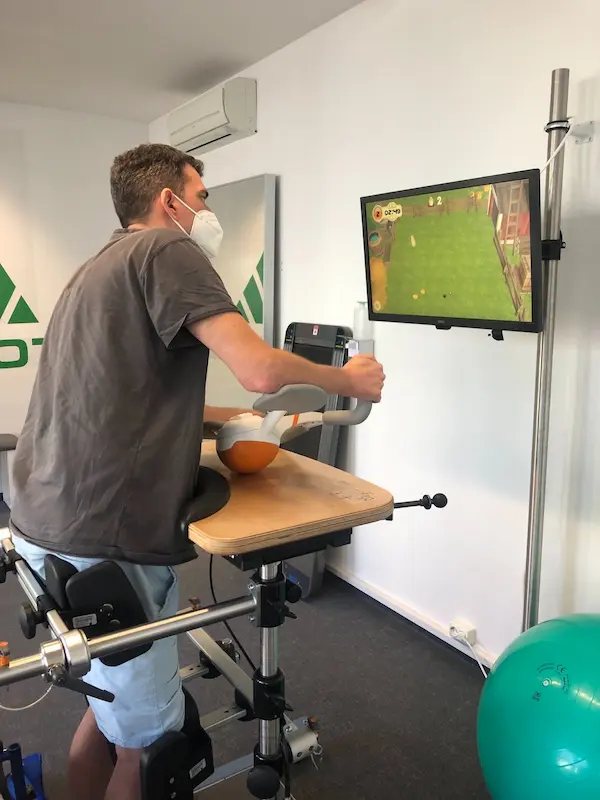
Multiple sclerosis in a progressive form. The process from the first symptoms to the diagnosis took a full year and a half.
Read the whole story →Answers to the most common questions about your condition and therapy — explained clearly and gathered in one place. So you can read at your own pace and come to your appointment well prepared and at ease.
In a free initial consultation we show you what is possible with your condition — in person, by phone or online.